
ASTM E1559 Outgassing Test Systems
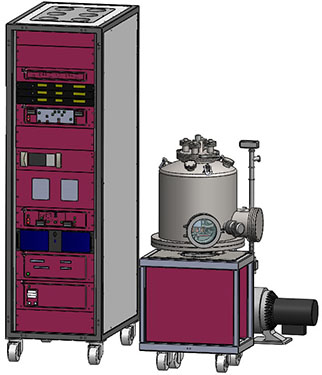 A self-contained, turn-key the ASTM E1559 Outgassing Test System features oil-free pumping with a dry scroll pump and turbo-pumps delivering vacuum pressure on the order of 10-8 Torr. The vacuum system operates by means of an air-operated gate valve and pneumatic valves.
By using a set of 3 thermally controlled Quartz Crystal Microbalances (QCM) and an inline SRS 300 amu RGA mass spectrometer, the outgassing and deposition rates can be measured continuously and the outgassing molecular components can be detected and identified. The integrated effusion cell heater and temperature sensors are critical elements for the success of the test. The facility is fully computer-controlled using a powerful proprietary COSIMOD™ software, thus all operations can be programmed to take place automatically.
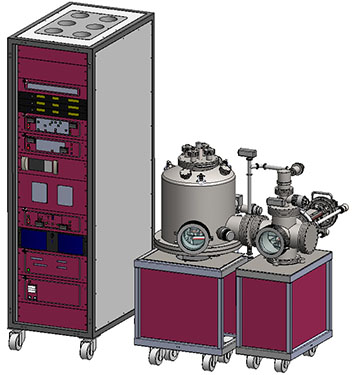 Responding to the need for dynamic outgassing testing at high temperature, SimulTek has developed and built the ASTM E595/E1559 Integrated Outgassing System that accommodates the set-ups for measuring the outgassing of materials according to both the ASTM E595 and ASTM E1559 test methods. A self-contained, turn-key the outgassing facility features oil-free pumping with a dry scroll pump and turbo-pumps delivering vacuum pressure on the order of 10-8 Torr. The vacuum system operates by means of an air-operated gate valve and pneumatic valves.
By using a set of 3 thermally controlled Quartz Crystal Microbalances (QCM) and an inline SRS 300 amu RGA mass spectrometer as described in ASTM E1559, the outgassing and deposition rates can be measured continuously and the outgassing molecular components can be detected and identified. The integrated effusion cell heater and temperature sensors are critical elements for the success of the test. The facility is fully computer-controlled using a powerful proprietary COSIMOD™ software, thus all operations can be programmed to take place automatically.
SimulTek OTS-E595|E1559 Features: • The 15 MHz Сryo-QCM sensors are set at various temperatures from 90 to 298 К for collecting the mass evolved. • Prepared materials are subjected to environmental temperatures ranging from ambient to 398-573 K in an effusion cell. • Interlock chamber loading of the effusion cell and a transfer mechanism for inserting the cell into the main chamber offer an increased testing convenience and simplicity.