
Lunar and Martian Environment Simulator Systems
SimulTek has built several configurations of the Advanced Planetary Environmental Simulator/Test Facility and associated with it methodology that involved the development of simulation environments that addressed the harsh conditions of the Moon, Mars, and other planets in a more efficient way.
SimulTek has designed, manufactured and assembled a modular design stainless-steel vacuum chamber ~ 40” in diameter and ~74” long that allows simulating ultra-high vacuum conditions (reaching the 10-8 mbar level), lunar dust particles source, Vacuum UV radiation sources (a dust charging module), thermal conditions/thermal cycling, and the ability to recreate the darkness conditions present on the back side of the Moon. The SimulTek Lunar Environment Simulator and Test Systems have the following major advantages: • The lunar soil simulant preparation module that offers an appropriate preparation of the lunar regolith simulant (JSC-1A or similar). This technology has the ability to bake out lunar dust simulants, or actual lunar regolith, under vacuum, then subjecting them to a hydrogen/argon/helium plasma and UV environment. Once activated, the dust can be applied to a sample, and then the coverage and adhesion of dust particles to the surfaces can be studied in such systems; • Hot/Cold Platform with an extended temperature range from -160°C to +160°C is an ultra-high vacuum set-up installed inside the vacuum chamber and designed to accommodate samples of different shapes and nature and to allow for heating, cooling, and thermal cycling of the samples; • Motion and Rotation System that allows to achieve linear, manual and computer-controlled motion of the sample at a rate of 10-100 mm/min, as well as rotation at a rate of 0.1-0.5 rad/min, along with heating/cooling of the sample at the same time; and • A new original design of a vacuum-compatible Tribometer that allows to perform tribological testing and can be used for materials abrasion and wear testing per ASTM G65 under simulated vacuum and lunar dust conditions. • The modular design of the facility allows to include a number of complementary technological space factor sources, such as the VUV/NUV, proton and electron radiation sources, contamination sources, etc., as well as a variety of fixtures and rigs for tribological testing of ball bearings, mechanical systems and mechanisms, fretting and fretting fatigue mechanical testing, as well as optical elements, electro-mechanical sensors, and spacecraft materials and coatings testing in the simulated Lunar planetary environment.
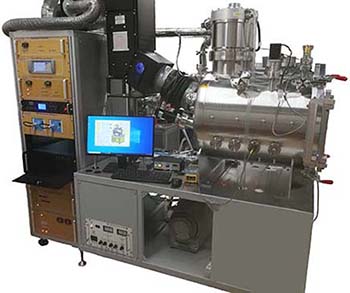
The BLESS™ is a new generation lunar environment simulator offered by SimulTek. It is designed for pumping out using a single turbo pump, has one door for servicing and installing and replacing samples and a platform for fixing samples, heating and cooling them. This modular design allows to increase the size of the vacuum chamber by adding another vacuum chamber, additional testing equipment and an additional pumping system. The BLESS™ system is an inexpensive, compact, and reliable system. The main features of BLESS™ system: • Filtration system that protects the pumps from dust ingress • Dust source combined with a dust preparation device • Two VUV lamps for charging dust using ultraviolet light • Heating/Cooling platform for mounting and thermal treatment of samples For more details see the PDF brochure below.
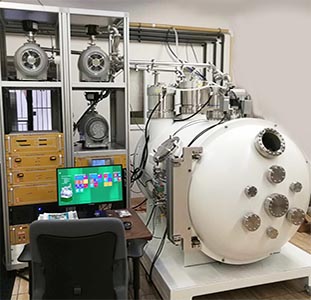
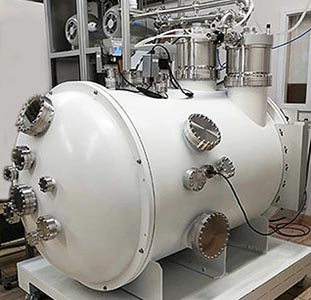
The ALESS™ is a unique simulator facility that is able to simulate the major environmental factors present on the Moon, i.e. lunar dust conditions, high vacuum, extreme temperature, UV radiation, and darkness. The facility is equipped with a data acquisition and data analysis system, which is able to perform real-time, in situ measurement of the vacuum pressure in the vacuum chamber, heat sink (cold shroud) temperature, intensity of UV radiation, basic lunar dust properties, etc. For more details see the PDF brochure below.
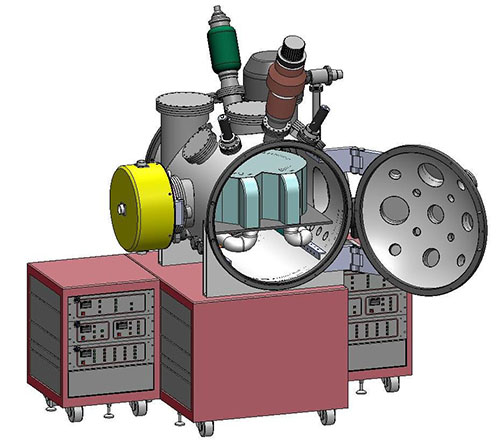
The simulator for creating the Martian environment is a system different from all other planetary simulators produced by Simultek (for example SimulTek–LESS). The main parameters of the Martian environment are as follows: • Surface gravity 0.38g • Mean surface temperature -600C • Surface temperature range -1450C to +200C • UV radiation spectral range ≥ 190nm • Atmospheric pressure 5-11 hPa • Mean PAR photon flux 8.6×10¹⁹ photons m-2s-1 • Atmospheric composition N2 0.189 hPa, 2.7% O2 0.009 hPa, 0.13% CO2 6.67 hPa, 95.3% Ar 0.112 hPa, 1.6% These parameters and determine the design of MESS system. The vacuum chamber is made of stainless steel and has a volume of 0.5-0.8m3. Pumping to a pressure of 10-2 Torr is carried out using a scroll pump C. A system for filling the gas mixture corresponding to the Martian has been developed. It consists of four MKS® GV50A Digital Mass Flow Controllers, each of which is connected to a cylinder with a corresponding compressed gas. To maintain the required temperature in the working chamber, a cryo shroud is provided. The heating of the gas mixture is carried out using electric heaters having a large surface. If necessary, for example, for thermal cycling, Hot/Cold Platform with an extended temperature range from -150°C to +150°C is installed that allows heating or cooling samples at a high (100C/s) temperature rate. To create microgravity (as usually during metal-physical, material-science and biological experiments), the MES simulator is setting by a Microgravity Simulator (MS) (see below). It is also possible to install a source of Martian dust (SimulTek-DPS, which works similarly to the lunar one and allows one to carry out tribological studies using a vacuum tribometer. All radiation sources such as the VUV/NUV, proton and electron radiation sources also designed and manufactured by Simultek and described in detail below.
Including the following main components: • Dust Pre-Treatment Unit (Dust Preparation Unit), • Dust Sprinkling Mechanism (Dust Cloud Forming Unit), and • VUV dust Charging Unit Main parameters: • Bunker capacity: To Be Defined • Type of actuator: Cool Muscle stepper motor • Actuator frequency: To Be Defined • Actuator amplitude: To Be Defined • Type of charge sensor: Faraday cup or Langmuir probe • Type of dust flow: Collecting cups • Type of VUV Source: Hamamatsu Deuterium Lamp • Type of Power Supply: Hamamatsu • Wavelength range: 115-200 nm • VUV intensity: 2-4 W/m2